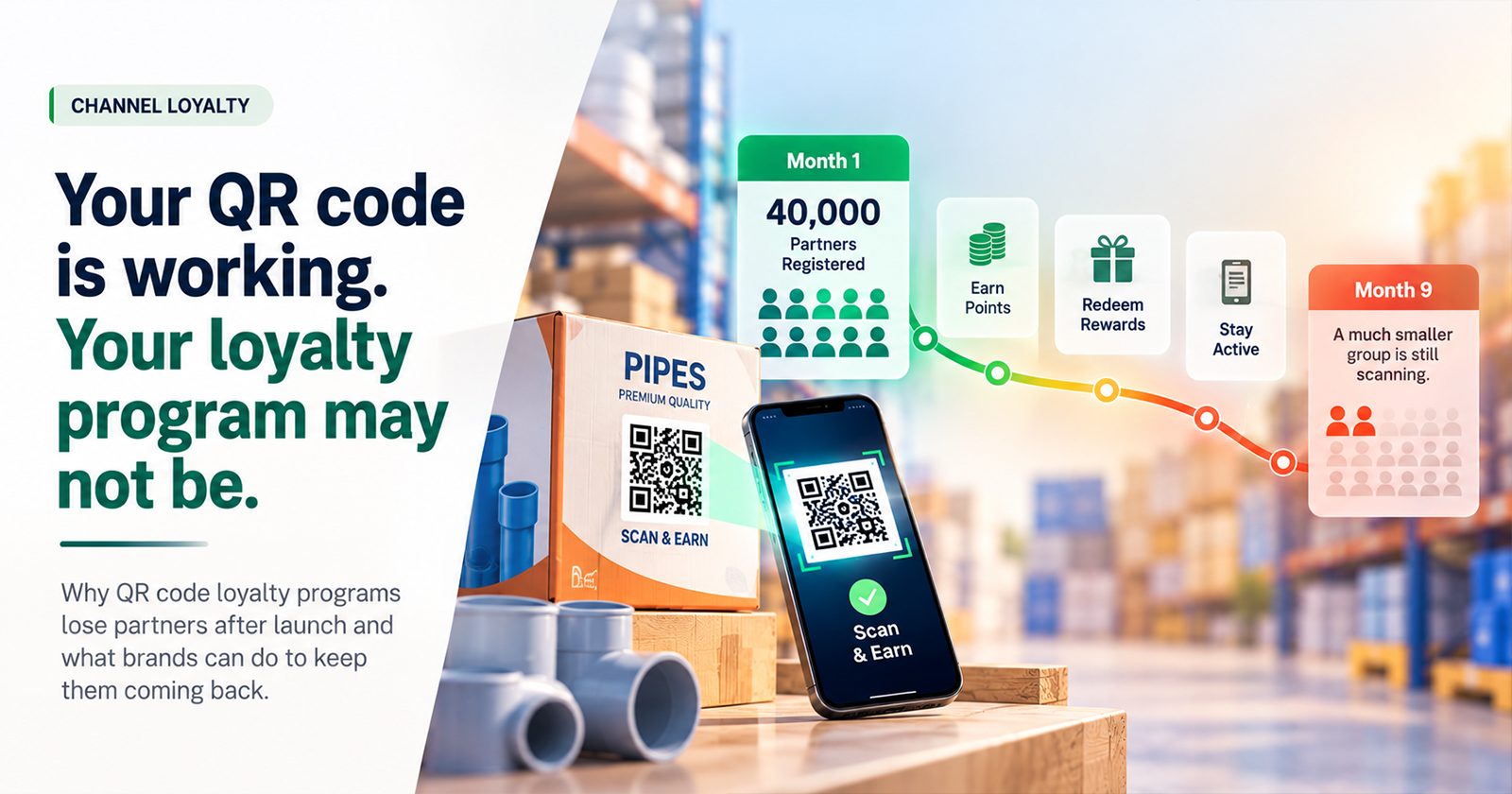
Your QR code is working. Your loyalty program may not be.
A QR code loyalty program can get 40,000 plumbers to register. That is the easy part.
The harder question comes nine months later, when the same brand looks at its programme and finds that a large part of those plumbers have not scanned anything in weeks.
The QR code is still printed on every carton. The app is still live. The points are still available. The partner simply stopped opening it.
Picture a pipe brand launching a scan-and-earn programme across four states. Launch meets happen at distributor locations. Territory teams explain the scheme. Dealers push registration. Within a few months, the numbers look good.
Then the scheme becomes one more thing competing for the plumber’s attention. This is where most QR programs are actually tested.
Everyone has a QR code now
A QR code on a carton is no longer a differentiator.

Pipes, paints, lubricants, cement, wires, fans and other channel-heavy categories use QR codes to connect products with rewards. The mechanic scans. The plumber earns. The painter collects points. The dealer sees the activity.
The technology works. The problem starts when the partner has to decide whether the next scan is worth his time.
Because he is not comparing your programme with nothing. He is comparing it with the other brands he deals with every day. And if all of them offer the same scan, points and catalogue experience, the smallest friction is enough to make him stop.
Four places a partner drops off
1. The reward arrives too late
Picture a mechanic at a dealer counter who scans a genuine product, earns points and redeems them for a mixer grinder. He waits three weeks.
Nothing is technically wrong with the transaction. His points were credited. His redemption went through. But the connection between the scan and the reward has become weak.
For a partner who earns and spends money every day, three weeks is a long time to wait before the programme feels useful. The next time he has a code in his hand, he has a choice. Scan it, or move on.
2. The programme speaks the wrong language
Picture a painter in Nagpur who is more comfortable reading Marathi. The programme communication arrives in English. His son helps him register once. At the dealer counter, someone explains how to scan.
The painter gets through the first transaction. The next time he has to figure something out himself, there is nobody standing beside him.
This is how language becomes an adoption problem without ever appearing as one in a programme review. The registration is complete. The partner still isn’t active.
3. Registration becomes another job
A partner is at a dealer outlet. There are customers waiting. His phone is in his pocket. The programme asks for multiple details and documents before he can start earning. He says he’ll finish it later. Then he goes back to work.
This is particularly important in channel programmes because the person registering is rarely sitting at a desk waiting for your form to load. He is selling, installing, repairing or serving a customer. Every extra step competes with the reason he opened the programme in the first place.
4. The label reaches the wrong person
Now consider a carton moving through a busy dealer. At closing time, counter staff collect labels and scan a batch together. The dashboard shows activity.
But the plumber or mechanic the programme was designed to reward did not do the scanning. The brand sees transactions. The intended partner sees little or no value.
This is the kind of leakage that can stay invisible if the programme is judged only by scan volume.
The launch is the easiest part to measure
Most QR programmes are reviewed through registrations, downloads and early scan numbers. That makes sense. Those are the numbers that move first. But they also tell you the least about whether the programme will survive.
Open your own programme dashboard and check one thing: of the partners who scanned during month one, how many are still scanning in month nine? Then break that number down by district, partner type and product category.
The result tells you something very different from total registrations. A programme can have 40,000 registered plumbers and still have a much smaller group that participates regularly.
The registration number tells you who entered. The month-nine number tells you who stayed.
The reward is not the real reason people stop scanning
The conventional response to falling scans is to increase the reward. That is often the wrong first move.
If a mechanic has to wait three weeks to receive a reward, adding more points does not remove the wait. If a painter cannot comfortably use the programme, a higher incentive does not remove the friction. If carton labels are being collected and scanned by someone else, paying more per scan can increase the leakage rather than fix it.
The non-obvious point is this: when participation falls, the first question should be what changed in the partner’s effort-to-value calculation, not how much more you can pay.
Design for month nine
The design choices that matter are practical.
QR-based earning needs to connect the physical product to the programme. The scan is the entry point. The programme then needs clear rules for what earns, how much it earns and what the partner can do with that value.
KYC and validation need to happen without losing the partner. Where identity and bank details are required, KYC, PAN and bank validation can be built into the redemption process rather than leaving the partner to complete a separate process later.
The reward needs to have usable redemption options. A partner saving for a specific product may prefer a catalogue. Another may prefer a direct payout route such as NEFT or UPI. The programme can support different redemption choices rather than forcing every partner into one format.
Programme rules should reflect the commercial objective. Brands can structure slabs, tiers, SKU-level rules, regional rules or growth-linked incentives rather than treating every scan as identical.
And there is one more operational issue that matters. The brand has to know when a programme is losing momentum. Not at the annual review. Not when the budget comes up for renewal. Early enough to act.
The month-nine test
A QR code loyalty program is easy to launch. Print the code. Put it on the product. Train the sales team. Start the campaign.
The harder work begins after the launch communication disappears from the dealer’s WhatsApp group and the territory manager moves on to the next scheme. That is when the programme becomes part of the partner’s routine, or becomes another app he no longer opens.
The test is simple. Go back to the partners who were active in month one. Look at month nine.
If a large part of the original base is still participating, the programme has done more than generate scans. It has created repeat behaviour. If it has not, the QR code was never the problem.
How My Incentives supports the programme layer
My Incentives is built for channel incentive and loyalty programs where physical product activity needs to connect with earning, validation and redemption.
GRG India brings 20+ years of experience in incentive and loyalty management across partner ecosystems.
The objective is not to make the QR code more complicated. It is to make what happens after the scan worth coming back for.
See a live QR code loyalty program
My Incentives connects the scan on the carton to verification, earning and payout — so the partner who did the work is the one who gets paid, and you can see who is still scanning in month nine.
Book a Demo