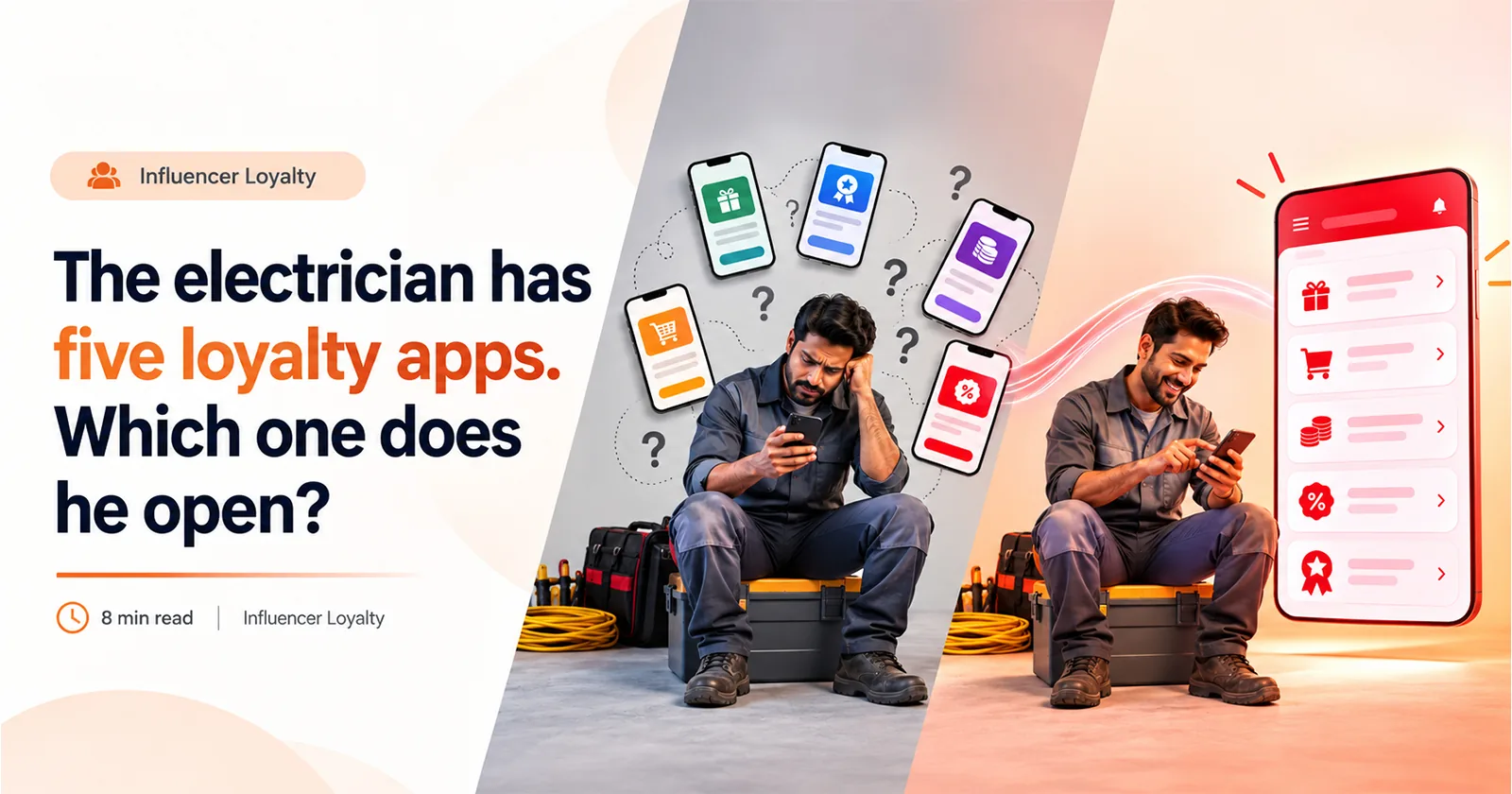
The electrician has five loyalty apps. Which one does he open?
An electrician in Lucknow has five loyalty apps on his phone. Two are from wire brands. One is from a fan brand. One is from a switchgear manufacturer. Another is from a lighting company.
He is registered with all five.
Now put him on a job where he is using your wire, MCB and switch on the same site. Which brand does he recommend next?
That is the real problem an influencer loyalty program has to solve. Not registration. Not downloads. Preference.
The electrician is already in your competitor’s programme
For years, manufacturers in electricals, plumbing, paints and building materials have known that the person influencing the purchase is often not the person making the payment.
The electrician specifies the wire. The plumber recommends the pipe. The painter influences the paint choice. The contractor decides which products make it into the project.
So brands built programmes around these influencers. The problem is that every competitor did the same thing.
The electrician from Lucknow is now sitting inside five programmes. Each brand sees a registered influencer. Each brand can report programme members growing. None of that tells you which brand he actually prefers.
Two electricians can produce the same number and mean completely different things
Take two electricians. Both generate 500 scans for your brand during the year.
Electrician A generates most of his scans in two months when your points are running high.
Electrician B scans consistently throughout the year. He also scans your wire, MCBs and switches across different jobs.
Same total scans. Very different signal.
If your influencer loyalty program rewards only the transaction, both electricians look similar. But if you are trying to build preference, they are not similar at all. One is responding to the scheme. The other is building a relationship with the brand through repeated use.
That distinction is where the programme gets interesting.
The race for registrations is over
A partner joining your programme is no longer a strong indicator of loyalty. He can join yours today and a competitor’s tomorrow. He can keep both apps. He can redeem from both. He can respond to whichever programme gives him the better reason at a particular point in time.
That means the programme needs to look beyond the size of the member base. The better question is: what does the partner do after he registers?
Does he keep participating? Does he use more of your range? Does he remain active when the market slows down? Those behaviours tell you more about preference than a registration number ever will.
Three signals that matter
1. Consistency
Start with the simplest one. How many months in the last year did the electrician actually participate?
A partner who scans in January, March, April, June, August, September and November is giving you a different signal from someone who produces a large volume during one promotional period. The total may look similar. The pattern is not.
2. Range breadth
Now look at what he is scanning. Suppose an electrician uses your wire, MCB and switch on the same site. That tells you more than three unrelated scans spread across a year.
He is engaging with multiple parts of your portfolio in one working environment. That is a stronger signal of brand preference because the brand is becoming part of how he does the job, not simply how he earns points.
3. Lean-season behaviour
Then remove the promotional noise. Look at what happens when there is no major campaign running. Does the partner disappear? Or does he continue participating?
This matters because an influencer who stays active when the incentive is quieter is behaving differently from someone who appears only when the reward becomes attractive. The programme should recognise that difference.
Your biggest points earner can be your least committed partner
The conventional view is that your highest-value partner deserves the most attention. But a high-value partner can be high-value because of a temporary incentive.
Imagine an electrician who generates a large number of scans during a three-month points multiplier. His annual total looks excellent. The following quarter, the activity drops sharply.
Now compare him with an electrician who generates smaller monthly volumes but keeps participating across the year and gradually adds more products from your range. The second partner can be more strategically important even with fewer total points.
The contradiction is simple: the partner who generates the most incentive cost is not automatically the partner who has developed the strongest preference.
Reward the pattern, not just the scan
This is where programme design can change the conversation. Instead of treating every scan as the same, structure the programme around the behaviour you want to encourage.
A partner who participates consistently across a quarter can move through defined tiers. A partner who engages across different SKUs can receive additional value for broader participation. Rules can also be structured around growth, regions or product priorities rather than paying a flat reward for every transaction. A channel loyalty program built this way can run several of those rule sets at the same time, for different audiences, on one platform.
The objective is not to make the programme harder to understand. It is to make the reward reflect the commercial behaviour that matters.
And points do not have to be the only reason for staying engaged. Recognition and other programme benefits can create value around the relationship without turning every conversation into a negotiation over points.
The programme cannot control every competitor
You will never have a complete picture of what the electrician is doing with five other brands. You do not need one.
Your own programme already tells you how consistently he engages, how broadly he participates and what happens when the promotional pressure reduces. That is enough to separate some very different types of partners:
- The occasional scanner
- The promotion-led partner
- The consistent partner
- The partner who is gradually expanding his use of your portfolio
They should not all look identical in your programme.
Preference is built through repeated choice
The goal of an influencer loyalty program is not to make the electrician delete the other four apps. That is unrealistic. The goal is to make your brand the one he repeatedly chooses when he has a real product decision to make.
That happens when the programme recognises more than the individual transaction. Consistency matters. Broader product use matters. Participation outside major promotional periods matters. And the programme has to be structured so those behaviours can actually influence what the partner receives.
A partner enrolled in five programmes counts as a member in all five. But he cannot give all five brands the same amount of preference on every job. That is the distinction your programme needs to capture.
How My Incentives supports influencer programs
My Incentives allows brands to structure incentive programs around slabs, tiers, SKUs, regions and growth-based rules, so the reward structure can reflect the behaviour the brand wants to encourage.
GRG India has been working in incentive and loyalty management for 20+ years across partner ecosystems.
The objective is not to win the registration race. It is to build a programme that gives the partner a reason to choose your brand repeatedly.
See a live influencer loyalty program
My Incentives records each scan against a named electrician, so you can see who participates consistently, who widens their use of your range, and who only appears when the points go up.
Book a Demo