Influencer loyalty program
Electrician loyalty programs for the brand installed in the home
The home owner rarely names a wire brand. The electrician does. The customer usually accepts the recommendation. GRG India runs the loyalty program for electricians.
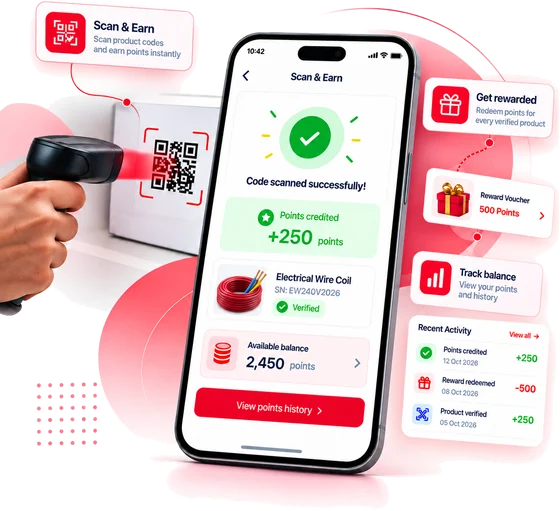
- Electricians earn on a code scan or an invoice photograph. The code is on the coil or the pack.
- Points are credited at once and shown in the app.
- Payment reaches the verified account of each electrician, usually within 24 hours of approval.
The program runs on My Incentives, the GRG India channel loyalty platform.
The decision
What the electrician decides on the job
The electrician is not on the brand payroll and does not buy in bulk. The sales data of the brand does not record the recommendation.
| Product | What the electrician decides | How the job is recorded |
|---|---|---|
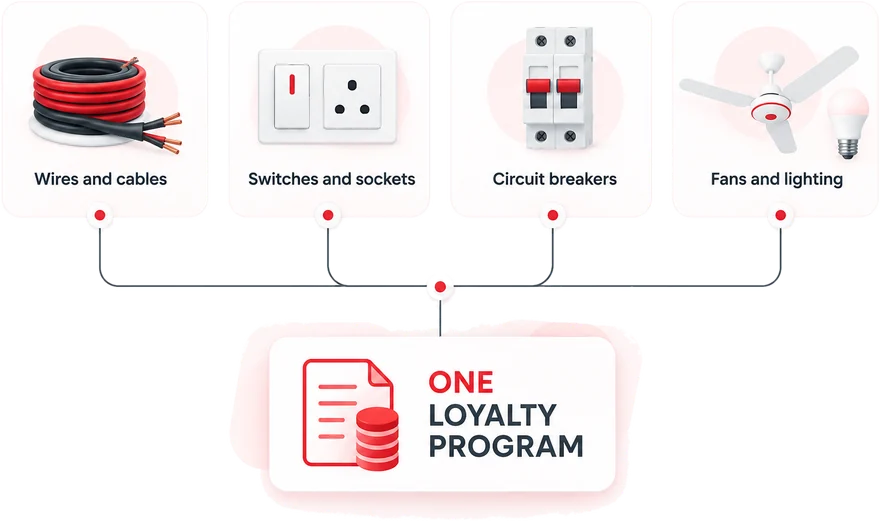
| Wires and cables | The brand and gauge pulled through the conduit | A code scan on the coil |
| Switches and sockets | The range fitted in every room | A code scan on the pack |
| Circuit breakers | The brand in the distribution board | An invoice photograph |
| Fans and lighting | The brand recommended to the home owner | A code confirmed by the dealer and the electrician |
An electrician loyalty program runs on the GRG India channel loyalty platform with one record for each electrician.
How it runs
Three steps from the job to the payment
The brand sets the budget and the scheme. The platform handles sign-up, recording and payout.
Sign-up and verification
The electrician signs up in the app or during a visit by the brand field representative. The platform checks PAN, bank account and mobile number before the first payment.
Recording the job
The electrician scans the code on the coil or the pack or photographs the invoice. Products with no code are recorded from the dealer sales feed.
Points and payment
The platform checks the claim against the program controls and credits the points at once. Approved amounts are paid by bank transfer, UPI or voucher.
Printed codes are often not ready on the launch date. An electrician incentive program starts as a scan and earn program on invoice photographs and dealer sales data. Printed codes are added to the same program on reaching the market.
How sales increase
Three people close the gap to the slab
The illustration follows one electrician through one cycle. The slab is 100 units. 82 units are recorded by day 20. Every figure is an illustration.
A message at the right time
A message names the 18-unit gap on day 20. The electrician can still reach the slab.
The brand field representative
The visit list shows the electrician 18 units short. The representative closes the gap during the visit.
Central analytics
400 of 1,000 electricians are within 20 units of a slab. The next campaign aims at that group.
The brand sets every slab and every rate. Wiring follows the building calendar. Rates change with the season as a setting.
Results
Changes on programs already running
Figures from trade programs for other influencer audiences on the same platform.
A scan code inside each box records the influencer at the site. Bank details are verified for each one.
The dealer and the applicator confirm the same code. One job produces one payment, split two ways.
The same platform runs the largest trade program GRG India operates.
Clients
Brands served by GRG India












Next step
A walkthrough of an electrician loyalty program for your brand
Tell us the product category and the number of electricians. We will show how the program would be set up for it.
The call takes twenty minutes and includes a screen share.
Or write to contactus@grgindia.in
FAQs
Frequently asked questions
What an electrician loyalty program is, how a job is recorded and how electricians are paid.
A program that rewards the electricians who choose and fit a brand on the job. The home owner rarely names a wire brand and the electrician usually does, but the electrician is not on the brand payroll and does not appear in the brand’s sales data. The program identifies each electrician, records the jobs and pays them directly.
By scanning a code on the coil or the pack, or by photographing the invoice. Products that carry no code are recorded from the dealer sales feed instead. Points are credited at once and shown in the app, and approved amounts are paid by bank transfer, Unified Payments Interface (UPI) or voucher, usually within 24 hours of approval.
The platform checks PAN, bank account and mobile number before the first payment. Sign-up happens in the app or during a visit by the brand field representative, and the verified account is the one the money reaches.
A program where the reward is triggered by scanning a code printed on the product or its packaging, rather than by a claim form. For an electrician that means scanning the coil or the pack at the job, which records the brand, the product and the person who fitted it in one step.
Yes. Printed codes are often not ready on the launch date, because they depend on the packaging run. An electrician incentive program starts as a scan and earn program on invoice photographs and dealer sales data, and the printed codes are added to the same program once they reach the market. The electrician records and the earning history do not restart.
The brand sets every slab and every rate, and the platform applies them as the data arrives. Wiring follows the building calendar, so rates change with the season. Those are settings rather than code, which is why a change does not wait on a software release.
Every claim is checked against the program controls before the points are credited, and PAN, bank account and mobile number are verified before an electrician can be paid at all. That means one person cannot hold several identities on the program.
Once an electrician crosses the threshold, yes. Section 194R makes the brand providing the benefit responsible for deducting 10 per cent of its value, and it applies once what one person receives in a financial year goes past ₹20,000. A busy electrician on an active scheme passes that well before the year is out, while an occasional one may never reach it, so the running total has to be tracked per person rather than per payout. Rewards in kind count the same as cash. That is why a verified PAN sits against every electrician record before the first rupee moves. The rule has applied since 1 July 2022. Confirm the treatment of your own scheme with your tax advisor.
Source: Income Tax Department, Government of India — Section 194R
Trade incentives run at 8 to 11 per cent of revenue for most organisations on McKinsey’s India-specific analysis, and up to 20 per cent for some. What that figure hides is how much of it reaches people the brand cannot name. An electrician scheme paid out as cash through the dealer, or as goods handed over at a counter meet, leaves no record of who received it or what they fitted. Recording the job against a named electrician is what turns that part of the budget into something a brand can measure.
Source: McKinsey & Company, “Reimagining trade spend”, June 2026
Yes, certificate GIS1115 under ISO/IEC 27001:2022, held by Tajonline (India) Pvt. Ltd. and issued by Shamkris Global Inspection Services. It carries more weight on this kind of program than on a dealer scheme, because an electrician program holds PAN and bank details for individuals rather than registered businesses, often tens of thousands of them, and those records sit on the platform for years. The certified scope names incentive and loyalty programs, so it covers this work directly rather than some other part of the business. Valid to 1 July 2027, and checkable by number on the certification body’s public register.
Source: Shamkris Global certificate register — check certificate GIS1115